


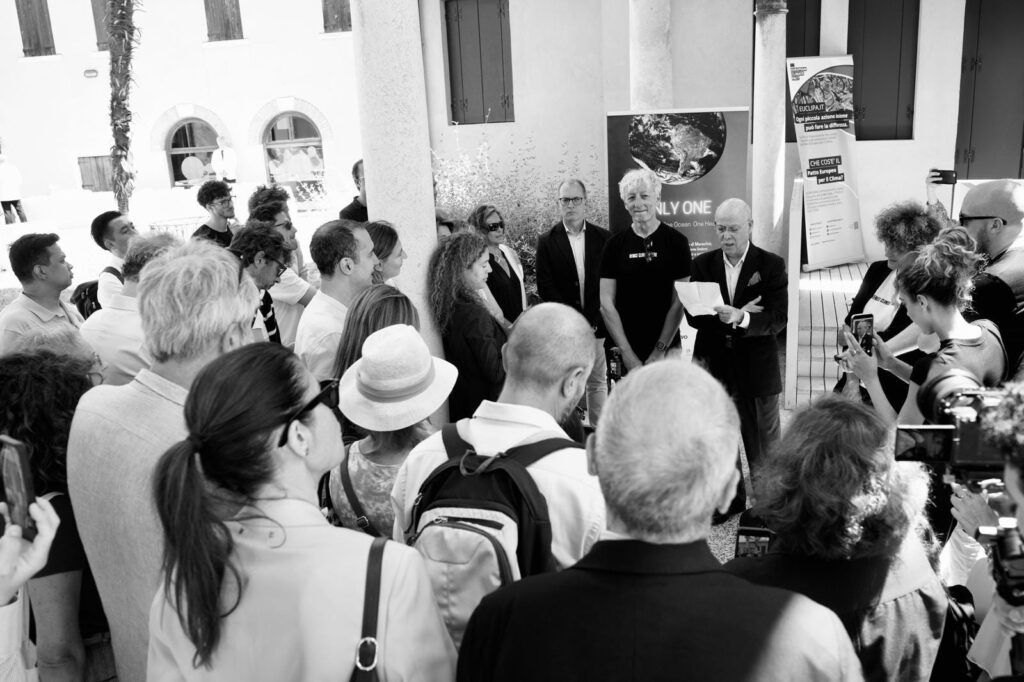
Sometimes you can feel history shifting not in parliaments or boardrooms, but in a room full of mayors and experts staring at flood maps.
That is what happened in Venice during this year’s Climate Week, on an island surrounded by water, under a title borrowed from Jeremy Rifkin’s latest book: Planet Aqua. Rifkin reminds us that the climate crisis is, above all, a water crisis – and that our political borders no longer match our hydrological reality. Cities, he argues, are now on the frontline of that mismatch: places where too much water and too little water collide with asphalt, inequality and fragile infrastructure. Once you really see that, you cannot unsee it.
As curators of Venice Climate Week – Riccardo Luna, Cristiano Seganfreddo and I – we have the privilege of not doing this work alone. We stand on the shoulders of two extraordinary allies: Francesco Musco and his academic team at IUAV University of Venice, who are rewriting the science and practice of water-resilient territories, and Stefano Pisani, mayor of Pollica, a pioneer of the “slow cities” movement and of what it really means to design and create a true Blue Community. Together with them, we strongly wanted to bring in C40 Cities and build a long-term collaboration grounded in real practices and tangible projects – not declarations – to create something that did not yet exist.
In 2025, we started inviting ANCI Italian mayors to Venice Climate Week because we felt they were the missing piece of the conversation. By 2026, we knew the challenge of cities was too big, too urgent and too global to treat as a side panel. So we did something that kept us awake at night – literally. We created the Planet Aqua Cities Award, and we asked C40 Cities to build it with us.
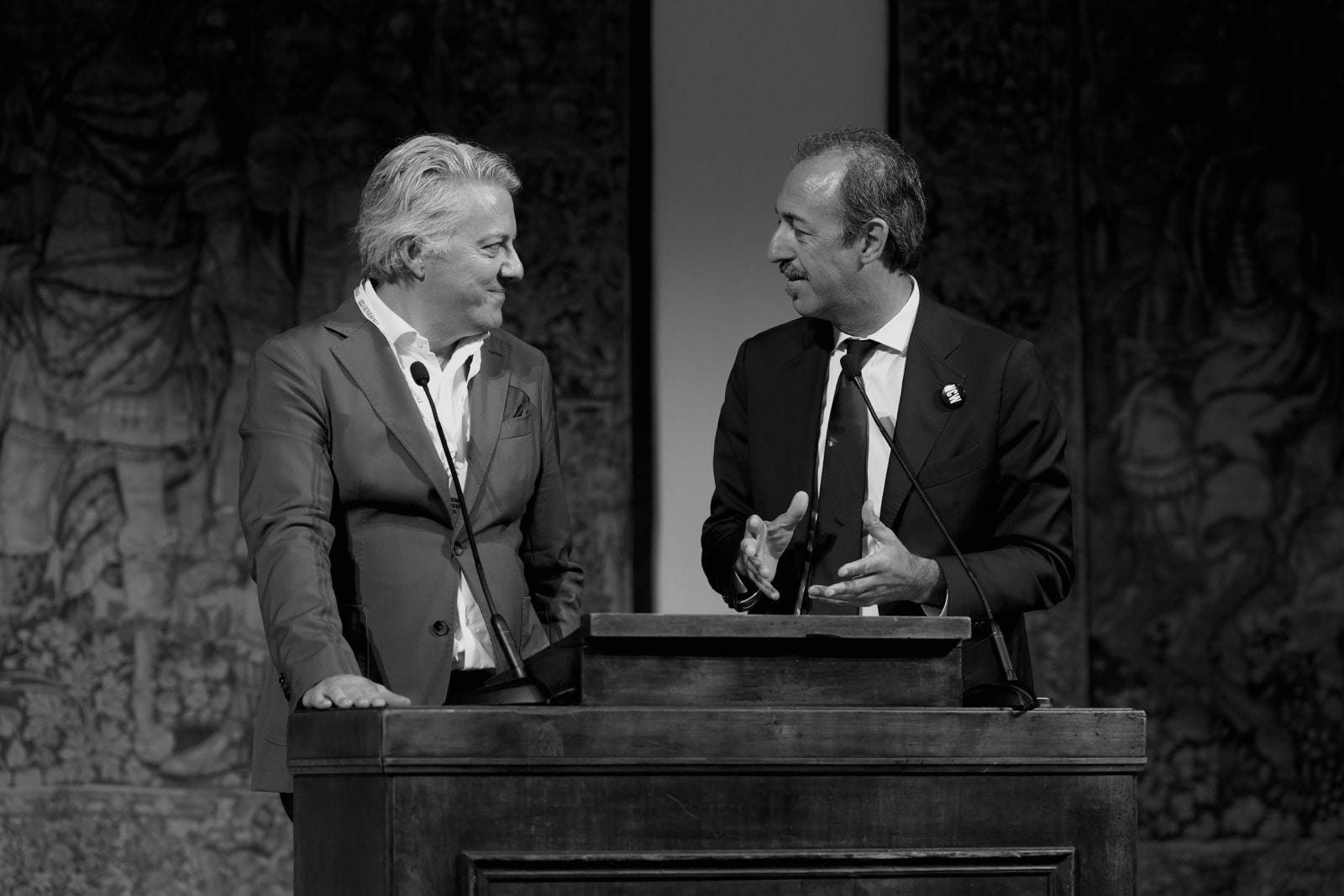
The C40 team – Amanda Ikert, Jennifer Wells and Jules Le Gaudu, together with Pedro Ribeiro, Celeste Espinazo and Lykke Leonardsen – and our partners at Swimmable Cities, led by Matthew Sykes, have been extraordinary travel companions throughout this first edition of the Planet Aqua Cities Award. They brought method, rigour and a deep understanding of city realities, and having Caterina Sarfatti with us in Venice for the awards ceremony made this feel like the start of a real, long-term collaboration grounded in practice, not just words.
Why C40, why now
If you care about climate action in cities, you know C40.
It is the network that brings together nearly 100 of the world’s leading cities to confront the climate crisis with science-based targets, shared tools, and a simple conviction: cities are not victims, they are protagonists.
On water, heat and nature, C40 has chosen to lean in hard. Through its Water, Heat and Nature programme and the Water Safe Cities Accelerator, it is helping cities design early warning systems, build nature-based flood defences, secure equitable access to water, and decarbonise their water and wastewater systems. It offers research, technical assistance and a common framework so that mayors from Manila to Medellín do not have to improvise alone in front of the same storm.
When we approached C40 with the idea of a Planet Aqua Cities Award, the answer was immediate: yes. Not because the world needs another trophy, but because we all felt a gap. We talk endlessly about climate finance, about international negotiations, about national targets. We talk much less about the people who actually sign the contracts, change the zoning codes and stand in front of citizens when the water rises: mayors and city teams.
The award was born out of that gap – and out of a very personal decision: to honour those who are not waiting for permission.
Designing the award was the easy part.
The hard part came when the applications started arriving.
We launched the Planet Aqua Cities Award with four categories and an open call. Thirty-seven projects arrived on our desks, from every climate zone and every income level, all answering the same question in different ways: how do you protect a city made of flesh and concrete in the age of Planet Aqua? We shortlisted twelve finalists, nine of them present in Venice, but the truth is that we could feel the energy of all thirty-seven behind every name we announced.
Together with the C40 team and our partners, we spent nights reading through projects from every corner of the world. Manila, Medellín, Cascais, Barcelona, Hong Kong, Jakarta, Amman, Quito, Fortaleza, Fuzhou, Phoenix, Quezon City… Twelve cities made it to the final stage, nine of them present in Venice. Each submission came with data, drawings, satellite images, budgets, community stories. Each one, in its own way, was a love letter to a city refusing to surrender to floods, drought, heat or coastal erosion.
We didn’t just evaluate engineering.
We asked: does this project protect the most vulnerable? Does it change the way a city thinks about water? Can it be replicated? Does it create beauty, not only safety?
By the time we had the shortlist, we were exhausted and exhilarated. Rifkin’s “Planet Aqua” no longer felt like a metaphor. It felt like a map drawn by mayors.
Frontline Protection: cities as early warning systems
Our first category, Frontline Protection, honours cities that are not satisfied with sirens and sandbags. They are rewiring their nervous systems, using data, sensors and artificial intelligence to see risk before it hits.
- Fortaleza, Brazil – Climate Risk Observatory (Runner-up)
Fortaleza built a Climate Risk Observatory that turns ten real-time weather stations, georeferenced data and environmental indicators into a live dashboard for decision-makers. It has already cut response times for civil protection and offers a model that any city with limited resources but strong data ambition can copy.
- Fuzhou, China – Urban Water System Scientific Dispatch (Runner-up)
In Fuzhou, often called a “Venice of the East”, the city created China’s first integrated platform for flood warning and emergency response. They call it the “Eyes, Brain, and Hands” system: IoT sensors, AI models and over a thousand automated assets coordinated through a single joint dispatch centre. It is operational, not theoretical.
- Quezon City, Philippines – iRISE UP (Winner)
Our winner, Quezon City, went one step further. The iRISE UP platform connects automated weather stations, sensors and AI-driven forecasts with the everyday reality of 142 barangays. It delivers hyper-local alerts, enables pre-emptive evacuations and, crucially, links data science with grassroots governance so that early warnings become early action, not just early panic.
Quezon City’s message to the world is simple: in the age of climate chaos, being “surprised” by a flood is a political failure, not an act of God.
Equitable Universal Access: no one left behind at the tap
We often speak about water scarcity as if it were a single number. Cities know better. They know scarcity is also about chi gets water, at what quality, at what cost.
L' Equitable Universal Access category celebrates cities that refuse to accept that the poorest neighbourhoods will always be the last in line.
- Cascais, Portugal – Water Resilience for Schools and Sports (Runner-up)
Cascais took a deceptively simple idea: start where people gather. By reusing pool water, harvesting rain and upgrading fixtures in schools and sports facilities, the city cut water use by up to 20 percent, engaging 17,000 citizens along the way. It is practical, scalable and deeply educational.
- Phoenix, USA – Pure Water Phoenix (Runner-up)
Phoenix chose courage. Facing historic drought on the Colorado River, the city launched Pure Water Phoenix, a programme for direct potable reuse of wastewater. Three advanced purification facilities will supply up to 290 million litres of safe drinking water a day, and to make that possible the city pushed to overturn a long-standing legal ban. Climate adaptation sometimes looks like new concrete; sometimes it looks like new law.
- Medellín, Colombia – Unidos por el Agua (Winner)
Our winner, Medellín, calls its programme Unidos por el Agua – United for Water. It works on three fronts: connecting households to formal water and sanitation networks, supporting community-based water supply, and enabling safe housing upgrades in low-income areas. The technical work is inseparable from community education, building a sense of shared ownership over every litre.
Medellín reminds us that water infrastructure is not just pipes and pumps. It is also trust.
Flood Protection: from climate liability to community asset
In Venice, we know what a flood feels like.
That is why the Flood Protection category was probably the most emotionally charged. These cities are building defences, yes, but they are also redesigning their relationship with water.
- Jakarta, Indonesia – Brigif Reservoir (Runner-up)
Jakarta’s Brigif Reservoir is a ten-hectare hybrid infrastructure project in South Jakarta, serving the Krukut watershed and the Kemang district. It uses nature-based solutions to retain floodwaters, reduce peak flows and protect downstream communities, while creating new green space in one of the world’s most flood-prone megacities.
- Amman, Jordan – Smart Urban Water Management (Runner-up)
In water-stressed Amman, rain is both a gift and a threat. The city’s green urban infrastructure initiative combines rainwater harvesting, permeable surfaces and new green spaces to reduce flash flood risk and manage chronic scarcity, particularly in vulnerable communities including Syrian refugees. It is a quiet revolution: using one intervention to address three crises at once.
- Quito, Ecuador – Isla Tortuga Rain Gardens (Runner-up)
Quito’s Isla Tortuga Rain Gardens Pilot created five rain gardens over 400 square metres to capture and infiltrate stormwater, handling up to 98 cubic metres per rainfall event. The project reduces flood risk, enhances biodiversity, cools the city and improves public space, all within a Horizon 2020 innovation framework.
- Cascais, Portugal – Flood Smart Stream (Winner)
And then there is Cascais again. The Flood Smart Stream project along the Sassoeiros stream eliminates 100 percent of local flood risk through four nature-based basins with 80,000 cubic metres of storage, designed for a once-in-a-century event. When the sky is clear, those basins become parks, playgrounds and cycle paths across 14 hectares of renaturalised green infrastructure and 4.6 kilometres of new routes.
Cascais has taken what was once a liability – a stream that flooded – and turned it into a community asset. It is what I call radical pragmatism: protect people, and give them a better city at the same time.
Coastal & Delta Resilience: learning from the edge
The last category, Coastal & Delta Resilience, felt almost like looking in a mirror. Venice is a low-lying city that has lived with water for a thousand years. We know what is at stake when the sea decides to rewrite the coastline.
- Hong Kong, China – Integrated Shoreline Management Strategy (Runner-up)
- Hong Kong’s Integrated Shoreline Management Strategy is a masterclass in planning for the long term. It updates climate parameters for extreme scenarios out to the end of the century, deploys tailored flood barriers, and builds nature-based “living shorelines” to boost marine biodiversity. It is cross-departmental, cross-sectoral and unapologetically ambitious.
- Freetown, Sierra Leone – #FreetownTheTreeTown (Runner-up)
- Freetown’s #FreetownTheTreeTown does not look like a traditional coastal project at first glance. It is a massive campaign of urban tree planting, mangrove restoration and watershed protection that addresses flooding, landslides, coastal erosion and water insecurity all at once. Over a million trees have already been planted and digitally tracked, with targets of 5,000 hectares restored and 5 million trees by 2030. It is a Global South city teaching the world what holistic, nature-based resilience really means.
- Barcelona, Spain – Coastal Resilience Strategy, Front Litoral (Winner)
- Our final winner, Barcelona, is rewriting its relationship with the sea. The Front Litoral transformation is creating a seven-kilometre climate-resilient waterfront spanning Mar Bella, Bac de Roda and Llevant, covering 18.5 hectares including a 12.7-hectare marine platform. Green infrastructure, sustainable drainage and biodiversity are integrated into spaces that residents actually want to use: beaches, promenades, meeting points.
Barcelona’s lesson is powerful: protecting a coastline and enriching a city is not a trade-off. It is the same project, if you are brave enough.
Beyond trophies: what emerged, and what we want next
As we handed out the awards in the halls of the Fondazione Cini, something became very clear: these cities are not waiting. They are not waiting for a perfect global agreement, for a new acronym, for a miracle technology. They are building early warning systems, rewriting water laws, reinventing drainage, creating living shorelines, restoring mangroves, and reconnecting heritage with innovation.
Three big messages emerged for me:
- Water is strategic infrastructure. Not a side topic, not a line in a utilities budget. It is the backbone of resilience, competitiveness and social stability.
- Cities must be co-designers of global and European frameworks. If we want the EU’s Water Resilience Strategy or the next UN Water Conference to matter, mayors and local communities have to be inside the decisions, not just in the photo.
- Nature is not a luxury. From rain gardens in Quito to mangroves in Freetown, nature-based solutions are doing the heavy lifting of climate adaptation while making cities more liveable.
What do we want next?
Read the full article on Subastack.