

From Pollica, a small Mediterranean village turned integral ecology lab, to Repower’s Innovazione & Turismo 2026 White Paper: how culture, food and community are rewriting what development and tourism
There’s a line in Repower’s new White Paper Innovazione & Turismo 2026 that hit me harder than the rest:
“The territory is not a resource to be exploited, but a living organism to be cared for, regenerated and passed on to future generations.”
It’s not a poetic tagline. It sits inside a report that tracks flows, dissects policies, compares case studies and asks a very concrete question: how can tourism become a real driver of development instead of a fast‑track way of burning through places?
For me, that sentence is not abstract at all. It is the short version of what I’ve been living, day in and day out, in Pollica.
When data finally backs the “stubborn” territories
The Repower report is the outcome of a collective effort: AI experts, infrastructure people, tourism practitioners, cultural operators, regeneration geeks, all around the same table. Its core thesis is blunt and refreshing: culture is not an add‑on sector, nor a bit of “content” you sprinkle on top to attract visitors. Culture is a structural part of how territories develop.
The numbers back this up. According to the White Paper, 61.8% of all tourist overnight stays in Italy happen in municipalities with a cultural, historical, artistic or landscape vocation — almost two out of three nights. In plain language: most trips are not driven by generic packages, but by living cultural ecosystems. Reducing culture to a pretty backdrop for Instagram is not only ethically poor; it’s economically shortsighted.
In the chapter on “Culture and regeneration”, the report doesn’t mince words. Culture cannot simply be bent to the needs of tourism without being hollowed out and creating serious imbalances. It actually works when it stays alive and present: generating new language, new social practices, new networks, new jobs. It works when communities are in the driver’s seat of this process, through education and schools, cultural institutions, foundations, theatres, libraries, hybrid spaces where everyday life and imagination constantly rub shoulders.
From Mediterranean village to global lab
Within this framework, Pollica appears as a case study with a telling subtitle: “From Mediterranean village to global laboratory of integral ecology”. The report recognises that here a small municipality chose to lead with a systemic vision and a rare level of coherence between public policies, culture and local development.
No talk of sunsets or “Instagrammable villages”. Instead, it traces a long trajectory: from the roots of Magna Graecia to the scientific codification of the Mediterranean Diet; from there to the creation of the Paideia Campus; to a land‑use plan built around the idea of “Food Scape”; to the construction of an ecosystem that links agriculture, landscape, education, research and community welfare.
In the “Takeaways” of the case study, Repower boils it down to three messages that, frankly, apply far beyond Pollica:
- Tourism is not seasonal consumption, but a slow, educational experience that generates relationships.
- Culture is not an event or a decorative layer, but permanent infrastructure that nourishes communities, health and ecosystem longevity.
- The territory is not a mine to be extracted, but a living organism to be cared for and regenerated.
Seeing this written down in a corporate White Paper made me look back at how many years of experiments, mistakes, prototypes and criticism it took before this vision could be described as “a replicable model for inner areas”.
What it really feels like to live inside a prototype
Reports flatten stories; they have to. On the ground, the transformation of a place is anything but linear.
There are pioneers and what, in Italian, I call cape toste — literally, “hard heads”: people who choose to look a bit further ahead when nothing is clear, approved or comfortable yet. People who pay the price of the prototype, the price of getting it wrong in public, of holding onto an intuition that sounds absurd to everyone else at first. It’s a privilege, yes. It’s also a heavy load to carry.
Pollica, in that sense, is not an abstract case study. It is a community of people who have decided to carry that load. Visionary mayors who, long before it was trendy, connected sea, land, health, community and territorial governance. The place where Ancel Keys chose to live when “Mediterranean Diet” was not a buzzword. The network of long tables that held generations together when conviviality didn’t yet have hashtags like “social tables” or “community experiences”.
All of this language is global marketing vocabulary now. In Pollica, it was just how life worked.
The White Paper nails a crucial truth when it notes that culture can guide tourism only if it is practised and recognised by the community, and backed by an institutional vision that holds over time. For me, that translates into something very concrete: putting education, research, agriculture, community and territorial wellbeing at the centre of policy, before any branding or promotion comes into play.
Some people are simply born with the duty to explore and pay the price of the prototype, of the “this will never work” idea. I’ve always called them cape toste. That awareness is exactly what led, together with other fellow travellers, to the birth of MISTAKE Academy: an educational space that treats error not as guilt but as a method, training a generation that can live with uncertainty, experiment and regenerate instead of just protecting the status quo.
Art, creativity and the “light infrastructure” of development
If you read the report with care, you see that art and creativity are not framed as mere aesthetics but as “light infrastructure” that can re‑wire places.
Look at the FOQUS experiment in Naples’ Spanish Quarters, also featured in the White Paper. A cultural and social initiative becomes both an engine of urban regeneration and a powerful listening device: a system that gathers data on tourist flows, on how public space is used, on the birth of new businesses. That allows the city to tell the difference between spontaneous growth and governed growth — and to act before distortions become irreversible.
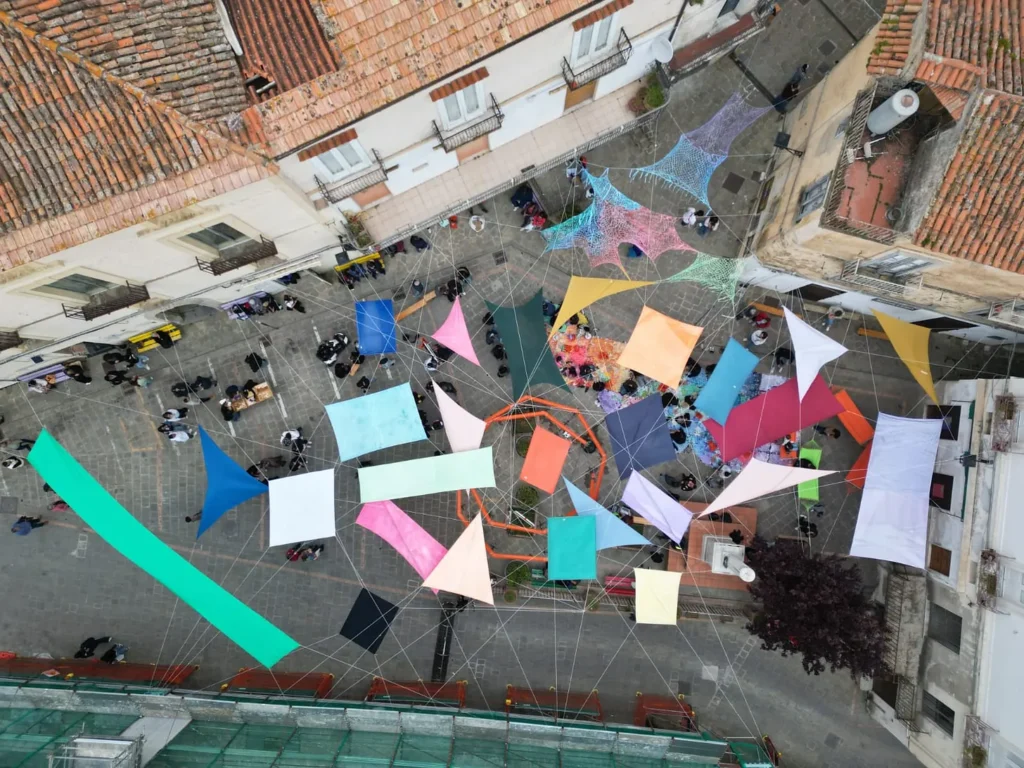
In Pollica we’ve been testing a similar approach with “Un Mondo È Possibile” (“A Possible World”), an artistic and scientific residency that brought more than eighty students, researchers and artists from the Naples Academy of Fine Arts and the University Federico II to the Paideia Campus. They didn’t arrive as tourists, but as temporary residents. They worked in the gardens and olive groves, listened to the community, turned the castle and the village squares into a distributed lab of artistic and scientific research. The community was not an audience; it was a co‑author.
It’s a very concrete example of how art and science can act as tools of regeneration, not just storytelling.
The White Paper also highlights projects like Rumors d’Ambiente, a podcast that listens to territories, people and businesses to surface stories of innovation, sustainability and local development. These are not PR gimmicks. They show how creativity and culture can morph into governance tools — helping territories understand themselves differently and act accordingly.
In Pollica, this creative layer often shows up as process rather than product: learning journeys, residencies, campus programmes that braid together art, food, science, craftsmanship, secular spirituality, landscape care. Moments in which aesthetics is not the end goal, but the excuse to build new relationships, make generations talk to each other, cross‑pollinate skills. That fabric is what makes a territory resilient.
Read the full article on Substack.