


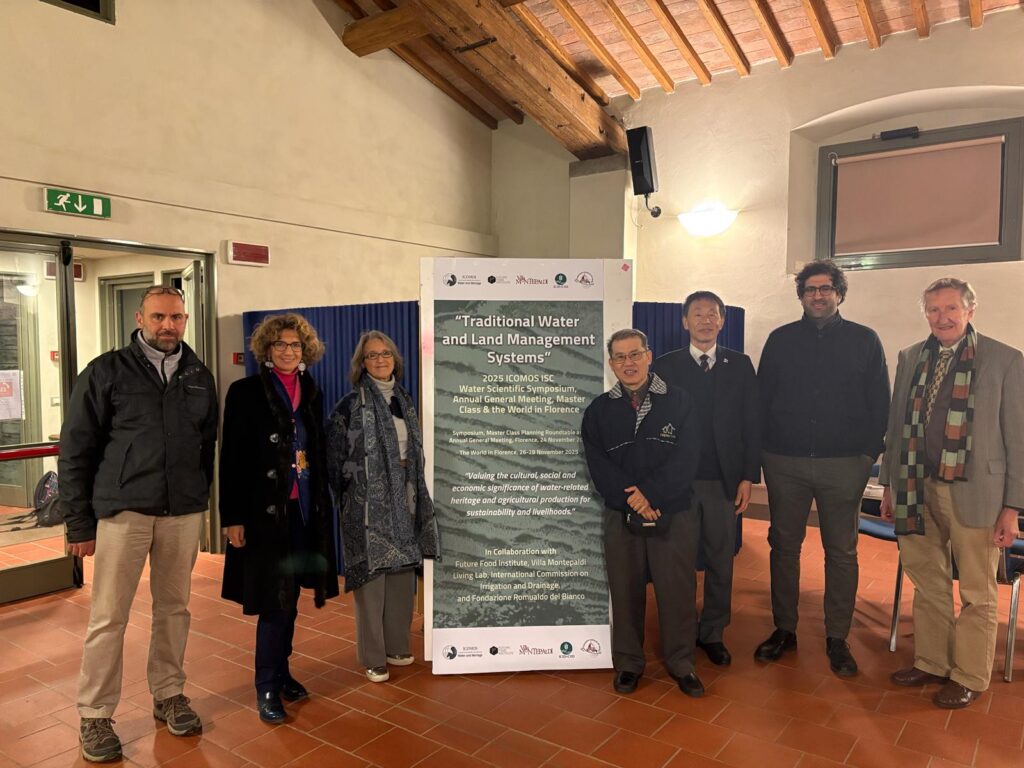
San Casciano in Val di Pesa, 24 November 2025 — The Traditional Water and Land Management Systems Scientific Symposium, Master Class Programming Roundtable and Annual General Meeting held at Villa Montepaldi brought together an international community of 50 water and heritage experts, farmers and researchers, academics and policymakers who called for more global attention to the fragility of traditional land and waterscapes, particularly in mountainous areas, due to depopulation, low economic profitability and the impacts of climate change. The Villa Montepaldi, a former Medici family estate tracing its origins to the Etruscan era, is notable as the location where Chianti wine was bottled for the first time and, since 2024, serves as a Living Lab for the Future Food Institute in collaboration with the Università degli Studi di Firenze.
The event featured keynote addresses by Sara Roversi, Founder and President of the Future Food Institute (FFI); olive farmer Lorenzo Caponetti of Casa Caponetti and FFI; Professor Wenjun Jiao of the Chinese Academy of Sciences (Beijing) and Member of the UN Food and Agriculture Organization’s (FAO) Globally Important Agricultural Heritage Systems (GIAHS) Scientific Advisory Group; Dr. Marco Arcieri, President of the International Commission on Irrigation and Drainage (ICID) and Permanent Observer to the UN FAO and International Fund for Agricultural Development (IFAD); Professor Paola Nella Branduini of the Politecnico di Milano and the WatHer (Water Heritage in European Rural Mediterranean) project; Carlotta del Bianco, President of the Fondazione Romualdo del Bianco; and Meisha Hunter, FAAR, AICP, President of ICOMOS International Scientific Committee on Water and Heritage and Senior Preservationist and Planner at Li/Saltzman Architects.
The event included a panel dedicated to terraced agriculture with examples from all continents, including China, Indonesia, Japan, Nepal, Spain, Chinese Taipei Committee ICID, pitches from India, South Korea and Turkey; and posters from China. The terraced agriculture case studies underscored the fragility of these traditional water and landscapes, which are vulnerable to climate change threats, terrace instability, low crop productivity, declining economic viability, and a growing dependency of local communities on tourism, which does not uniformly benefit all agricultural communities equally. In addition to sharing concerns, participants agreed upon the importance to reach out to policy makers for action, for researchers to work on practical paths forward and for the tourism industry to become actively involved in sustainably enhancing the livelihoods of local communities and ecosystems.
A centerpiece of the Symposium was a programming roundtable to discuss experiences and establish a methodology for evaluating traditional water and land management systems; with delegates representing Delft University of Technology (TU Delft), University of Pune, IHE Delft Institute for Water Education and Global Network of Water Museums, Politecnico di Milano, ICOMOS Italia, the Department of Agriculture, Food, Environment and Forestry (DAGRI) of the Università degli Studi di Firenze, UNESCO Chair for Science and Cities, and ICID. The programme concluded with the ISC Water’s Annual General Meeting, with representatives from ISC Water’s Bureau, ICOMOS Malaysia, ICOMOS Morocco, ICOMOS Netherlands, ICOMOS Australia, and the ICOMOS International Scientific Committee on Cultural Landscapes; as well as the presentation of a draft Montepaldi Statement by Henk van Schaik, Honorary Vice President of ISC Water.
The programme, which embodied multidisciplinary knowledge sharing, diverse perspectives, richly textured dialogue and a diversity of cases, reinforced the value and significance of traditional water and land management systems for sustaining livelihoods and helping to meet the the water and food needs of today and tomorrow. Amidst challenges of climate change, economic pressures for farmers, soil erosion, and depopulation/shifts of young people away from farming, the need for raising awareness about traditional water and land management stewardship is increasingly urgent. On the global stage, uniting voices and joining hands together can result in a stronger message than each might achieve on their own.
The Symposium’s outputs included (1) issuing a Montepaldi Statement; (2) catalyzing a growing network of partners committed to organizing a multi-disciplinary and practical/ solutions-oriented Master Class for students and farmers at Villa Montepaldi (date TBD); (3) fostering an international consortium of allies united in expressing concerns and opportunities for traditional water and land management to sustain livelihoods, both at regional and global levels, including the United Nations World Water Conference (UAE December 2026), the Venice Climate week (June 2026), the ICOMOS General Assembly (Malaysia October 2026), and the “Il Valore dell Acqua“ Conference (Milan, June 2026); and (4) announcing a forthcoming call for submissions to be considered for publication in the Symposium’s proceedings to be organized by ISC Water.
The programme was organized by the International Council on Monuments and Sites (ICOMOS) International Scientific Committee on Water and Heritage, in partnership with the Future Food Institute, the Villa Montepaldi Living Lab, the Fondazione Romualdo del Bianco Life Beyond Tourism and the International Commission on Irrigation and Drainage with participation by ICOMOS Italia.
For more information, please contact the ISC Water at iscwater@icomos.org.